
Why Local Marketing Has Changed So Much for Service-Based Businesses
Your Google Business Profile is now more important than your website. Here’s what that means if you’re a roofer, plumber, electrician, or any local service pro, from North County San Diego to anywhere else in the country.
The Shift Nobody Warned Local Service Businesses About
Picture the last time you needed a plumber at nine o’clock on a Saturday night, or an electrician right after your breaker panel started smoking. You didn’t type a company’s web address into your browser. You searched. Google handed you a map with three businesses highlighted in a little box, and you picked one of those three, probably by star rating, phone number, or whoever looked closest. The decision happened almost entirely inside Google’s own interface. The company website barely entered the picture until after the choice was already half made.
That’s the story behind a shift that almost nobody has explained clearly to the business owners it affects most. If your business depends entirely on local clients, if you’re a roofer, a plumber, an electrician, a landscaper, a pest control company, an HVAC contractor, an accountant, or a lawyer working inside a defined service area, the rules you built your marketing strategy around have quietly changed underneath you. For years, the conventional wisdom said the website was the center of gravity. Build it, optimize it, wait for it to rank, and treat everything else as a supporting cast member. That model no longer matches reality, and the businesses still operating under it are losing ground every single month to competitors who figured this out first.
It doesn’t matter whether you landed here researching search engine optimization on your own, comparing SEO services before hiring anyone, weighing a digital marketing agency against a narrower internet marketing service, or wondering why the advertising agency you already pay hasn’t mentioned any of this. The underlying mechanics are the same for everyone, and they all start in the same place: the map pack.
The map pack, that small cluster of three businesses Google shows above the regular search results, is now powered primarily by your Google Business Profile, not your website. For local service businesses specifically, GBP has become the main event. The website hasn’t disappeared. It’s been demoted to a supporting role, and understanding that difference is the single biggest mental shift a local business owner needs to make right now.
Who This Actually Affects
This isn’t a universal rule. A national e-commerce brand or a software company without a physical service radius still lives and dies by its website and its content. But if you’re a local, service-area business, meaning customers search for you by location and you either travel to them or they travel a short distance to you, this shift lands directly on your doorstep. Roofers and general contractors. Plumbers and electricians. Landscapers and lawn care crews. Pest control companies. HVAC technicians. Accountants, bookkeepers, and tax preparers. Lawyers running a local practice. Home cleaning services, junk removal companies, movers, auto repair shops, mobile mechanics. If any part of that list sounds like you, the map pack is your storefront now, and ranking there consistently across your entire service area, not just at your front door, is the single highest leverage move available in local marketing today.
Introducing How We Track It: Our Heatmap Ranking Tool
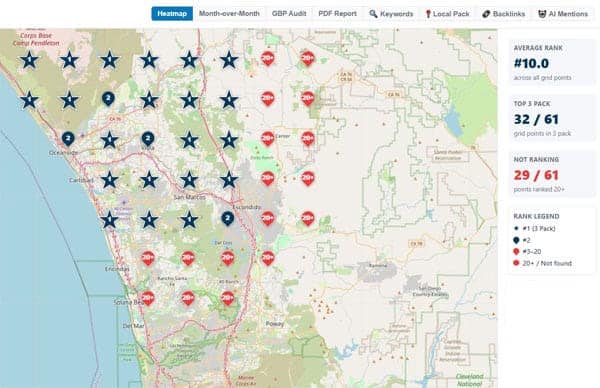 Before going further, it’s worth explaining how rankings actually get measured for our clients, because “you rank well” is a meaningless sentence without proof, and a single “you’re ranked fourth” snapshot from one address tells you almost nothing about how a business performs across an entire service territory.
Over the last several months, we built a proprietary local rank tracking tool from the ground up. Not a subscription to somebody else’s platform, but a system we designed and continue to sharpen ourselves. Conceptually, it works similarly to well known local SEO tools like LocalDominator or BrightLocal, the kind of software agencies use to visualize local pack rankings across a geographic grid. But we built ours around exactly how we run local marketing for our own clients, and it goes deeper in a few specific ways.
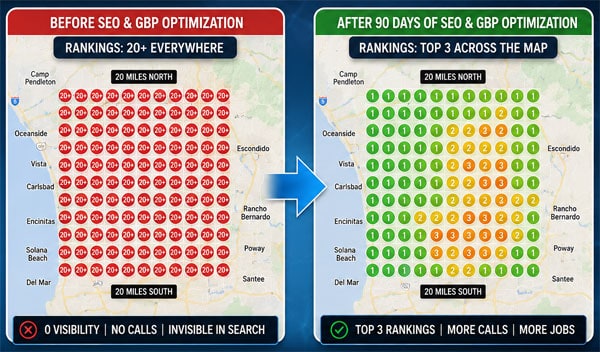
Here’s what it does. Instead of checking a ranking from one point, your business address, it runs a grid scan across the entire service area, checking local pack position at points spaced roughly five miles apart in every direction. So if you’re a roofer covering a fifteen to twenty five mile radius, we’re not handing you a single number and calling it a report. We’re showing you exactly where you rank at every five mile increment across the whole territory you actually work in. That’s the difference between one data point and a real map of visibility.
Results are color coded for instant clarity. Green means a top three ranking, the map pack itself. Yellow means fourth through tenth, visible but not prime. Red means anything past page one. Alongside the ranking grid, the tool runs backlink analysis and city level keyword search volume research, so we’re not only measuring position, we’re identifying which keywords in which nearby cities carry real search demand worth chasing. Every scan gets saved, so we can pull one from three months ago next to today’s and show a client, side by side, exactly how visibility has expanded or where it’s stalled across the entire coverage area.
We know North County San Diego best. We’ve run a top web design and marketing firm here for twenty years, in Vista, Oceanside, Carlsbad, Encinitas, San Marcos, Escondido, Fallbrook, and every neighborhood in between, and there’s no substitute for two decades of watching one region’s search behavior evolve up close. But the tools in our arsenal don’t stop at local knowledge. Between the heatmap system described above and the AI assisted research and content tools we use daily, including Claude Pro, we’ve ranked clients into the top three local results in markets all across the country, not only here at home. Local expertise plus the right technology travels well, and that combination is exactly what separates a business that guesses at its rankings from one that actually watches them move.
The Three Pillars of Local Ranking
Everything Google does with local search results comes down to three factors, and understanding them changes how you prioritize your marketing budget.
Proximity is how close the searcher sits to your business, or for service area businesses, to a location within your declared service area. You can’t fully control this, but you can influence it by setting your service areas accurately in GBP instead of leaving them too narrow or absurdly broad.
Relevance is how well your profile matches what the searcher typed. This is driven by your business categories, your services list, your business description, and the words that show up inside your reviews.
Prominence is how well known and reputable Google believes your business to be, driven by review volume and quality, citation consistency across the web, backlinks, and general engagement signals. This is the factor most local service businesses neglect completely, and it’s what separates the businesses stuck in the yellow zone from the ones sitting comfortably in the map pack across their whole territory.
Every tactic that follows exists to move the needle on one of these three factors.
What GBP Optimization Actually Means Today
Optimizing a Google Business Profile isn’t a one time setup task. It’s an ongoing discipline, and most businesses do the bare minimum and stop there. A properly optimized profile includes accurate primary and secondary category selection (your primary category carries real ranking weight, and getting it wrong is one of the most common, most costly mistakes we see), a complete and specific services list, GBP products where applicable, a business description written for actual humans that includes the terms real customers search for, correctly configured service area settings, and every relevant attribute filled out: licensed, insured, years in business, and so on.
None of this is exotic. It’s mostly free information Google gives every business owner that most never bother to complete. Because so few competitors fill it out fully, doing it properly is often enough, on its own, to create real separation.
Reviews: Quantity, Recency, Response, and the Words Inside Them
Most digital marketers will tell you reviews matter because they build trust. Fewer will tell you they’re also a direct ranking input. Google pays attention to review volume relative to competitors, how recently reviews are arriving (a business with eighty reviews from three years ago and nothing since looks stagnant next to a competitor adding new ones every week), whether the owner responds, and, less obviously, the actual language used inside those reviews.
When a customer writes “best emergency plumber in Oceanside,” that phrase becomes part of the relevance signal tied to your profile. Review generation shouldn’t be a passive, hope for the best process. It should be active and ongoing, with a simple, repeatable way to ask every satisfied customer, and a habit of responding to every review, good or bad, because response rate itself is something Google tracks.
Photos, Videos, and GBP Posts
Google rewards profiles that show ongoing activity, and photos remain one of the easiest, most underused levers available. Fresh photos of job site work, before and after shots, the crew, the trucks, signal an active business, and profiles updated regularly outperform static ones that haven’t changed since setup.
GBP Posts function like a small social feed built into the profile itself: short updates about promotions, completed jobs, or seasonal services. Almost no local service businesses use this consistently, which makes it a low effort, high relative impact opportunity for the ones that do.
FAQs Still Matter. They Just Moved
Here’s a wrinkle that trips up a lot of business owners. Google used to let businesses build a public question and answer section directly on the Business Profile itself. That feature is gone. Google removed the ability to post FAQs inside GBP a while back, and it isn’t returning in its old form.
That doesn’t mean FAQs stopped mattering. It means they moved. A well built FAQ section on your website now does double duty. It feeds Google’s local and organic algorithms with clearly structured question and answer content, especially when marked up properly with FAQ schema, and it’s exactly the kind of content AI driven answer engines and AI Overviews reach for when someone asks a conversational question like “how much does it cost to fix a roof leak in Escondido.” A website without a real, substantive FAQ section is leaving one of the most valuable pieces of AI visibility real estate untouched, precisely because GBP no longer offers a native home for it.
NAP Consistency and Citations
NAP stands for name, address, and phone number, and it needs to be identical, down to the formatting, everywhere your business appears online: your website, your GBP, Yelp, industry directories, chamber of commerce listings, all of it. Inconsistent NAP data, a slightly different phone number here, an outdated business name there, is one of the quieter ranking suppressors in local SEO, because it makes Google less confident that all those listings represent the same real business. Cleaning up citation consistency is unglamorous work, but it’s foundational. You can do everything else right and still get held back by conflicting business data scattered around the web.
So Is the Website Dead?
No, and this is the part that gets misunderstood most often. The website’s role has changed, but it hasn’t become optional. It shifted from primary ranking surface to the supporting structure that reinforces everything your Google Business Profile is trying to say. A weak or neglected website will still hold back an otherwise well optimized GBP.
A properly optimized website for a local service business needs, on every single page, structured data (schema markup) that tells Google plainly what the page covers and which business it belongs to. It needs an AEO, or Answer Engine Optimization, block near the top of key pages: a plainly written question and answer snippet that gives both Google and AI answer engines an easy, quotable summary of what you do. It needs a keyword friendly H1 and properly structured H2s that reflect how real customers actually search, not internal company jargon. It needs a strong, unique title tag built around a keyword people genuinely type into Google, not a generic template repeated across every page, and a written meta description that gives someone a reason to click.
Two more elements matter more than most business owners realize. First, embed a live Google reviews feed directly on the website, a widget pulling in your real, current Google reviews, rather than static testimonial text typed into the page by hand. Visitors trust real, verifiable Google reviews far more than testimonials a business could have written itself, and a live feed keeps that social proof current with zero manual work. Second, embed your Google Business Profile map, the same map Google displays in search results, somewhere present sitewide, commonly the footer. It reinforces your location and service area on every page a visitor lands on, not just a dedicated contact page.
And above everything else on this list: the services listed on your Google Business Profile must match the services listed on your website. It sounds obvious, but it’s one of the most common gaps we find. If your GBP lists water heater installation as a service and your website never mentions it anywhere, you’re sending Google a mixed signal about what your business actually does, and mixed signals suppress relevance across both properties at once. Your GBP services and your website’s service pages should mirror each other, service for service, no exceptions.
Common Mistakes Local Service Businesses Make
A handful of patterns show up again and again across every industry this affects. Picking the wrong primary category, or never revisiting it as the business grows. Leaving service areas either too narrow, missing real customers, or absurdly broad, diluting relevance everywhere at once. Letting reviews sit unanswered for months at a time. Treating the website and the Google Business Profile as two disconnected efforts instead of one coordinated system with matching services, matching messaging, and mutual reinforcement. And measuring rankings from a single address instead of understanding how visibility actually shifts across the real geographic territory being served, whether that’s North County San Diego or a service area three states away.
How to Actually Track Progress
This is where the heatmap approach described earlier stops being a nice to have and becomes essential. Local rankings aren’t static, and they’re never uniform across a service area. A business can sit comfortably in the map pack near its own address while being completely invisible fifteen miles out, in neighborhoods generating just as much real revenue. Rescanning that full grid on a recurring basis, monthly is typical, and comparing it against saved historical scans, is the only way to see whether the optimization work is actually moving the needle across the territory that matters, not just at one convenient point on a map.
The Takeaway
Local search has changed fundamentally for service area businesses, and the ones who recognize it first gain a real, compounding advantage over competitors still treating their website as the whole strategy. The Google Business Profile is doing the heavy lifting in the map pack now. The website needs rebuilding to reinforce it rather than operate on its own. Neither one works in isolation anymore.
If you run a roofing company, a plumbing business, an electrical contracting firm, a landscaping crew, a pest control company, an HVAC business, an accounting practice, or a law office, anywhere your customers search for you nearby rather than by name, this is worth auditing sooner rather than later. Every month spent guessing is a month a competitor spends closing the gap.
Internet Solutions Web Design is a digital marketing agency and search engine optimization agency that has been building websites and local marketing strategies for North County San Diego businesses since 2006, based in Vista and serving Oceanside, Carlsbad, Encinitas, San Marcos, Escondido, Fallbrook, and the surrounding communities, with a track record of top three local rankings for clients well beyond San Diego County too. Whether you’re comparing SEO services, researching Google Business Profile optimization, or looking for an internet marketing service built around your actual service area instead of a one size fits all package, we offer transparent, flat rate pricing with no long term contracts: Google Business Profile Optimization and Local Area Marketing starting at $299 a month, and direct one on one marketing consulting at $50 an hour with no minimum. If you’d like to see exactly where your business currently ranks across its service area, reach out. We’re happy to walk you through it.*
